Tag: Economy

  • Trump Tariffs & the Global Trade War: Impact on Indian Markets

    Trump Tariffs & the Global Trade War: Impact on Indian Markets

    Trump's Tariffs Will Increase Prices and Empty Shelves Within Weeks - Business Insider


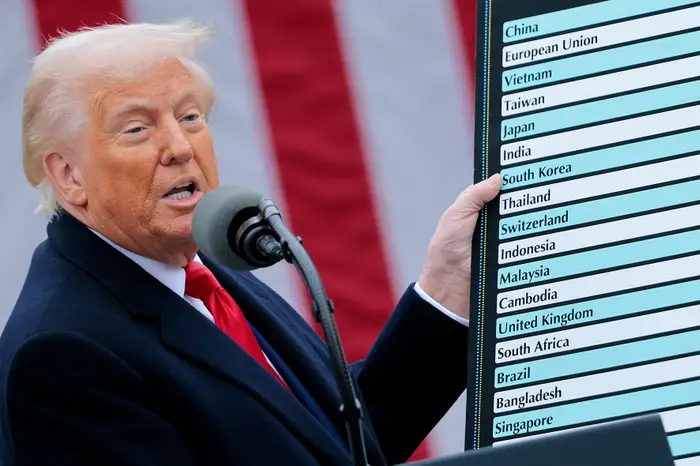
    Trump tariffs India markets: Beginning in 2018, the Trump administration unleashed a broad trade war. It slapped 25% tariffs on imported steel and 10% on aluminum, then applied a 10% surcharge on nearly all imports and much higher rates on key partners​. By April 2025, the US announced “reciprocal” tariffs targeting India (26%) along with China (54%), the EU (20%), Japan (24%) and others. These moves pushed America’s average import duty to the highest level since World War II​, sparking fears of a prolonged global recession. The World Trade Organization’s Pamela Coke-Hamilton warned that the turmoil could shrink world trade by about 3%, as supply chains reorient toward India, Brazil and other emerging markets​. In short, the new tariffs have dramatically raised prices and uncertainties worldwide, fueling volatile reactions in India.

    Impact on Indian Markets (Short Term)

    Indian stock markets plunged on news of the tariffs. BSE Sensex and Nifty 50 dropped about 5% in a single session​ – one of the worst falls in years. By April 7, 2025, BSE market capitalization had lost over ₹14–19 lakh crore (trillions of rupees)​. Broad indices were dragged down by heavy selling in companies tied to the US economy. For example, Tata Group firms (large US exposure) saw their combined market value shrink by ~₹2.4 lakh crore​. Other sectors hit hard included automobiles, metals, IT services, pharmaceuticals, textiles and gems​.

    Economists attribute this sell-off to panic over higher import costs and slower export demand. Foreign funds withdrew from Indian equities, and investors sought safer assets. Gold prices and government bonds rallied while the rupee slid to multi-month lows under the pressure. Analysts note that companies with large U.S. business (consumer goods, tech services, etc.) saw the steepest declines, as investors “offloaded shares of companies with US exposure” amid fears of a worldwide downturn​. Overall, the tariff shock triggered a bout of extreme volatility in Indian markets, wiping out years of gains in days.

    Stock Market Reaction

    Investors immediately turned bearish. Indian equities were hit by a wave of margin calls and panic selling. On April 7, 2025 Sensex and Nifty each fell roughly 5% in one day, only recovering some losses at the close​. That “Black Monday” erased decades of gains for the day, costing the average investor ₹14.2 lakh crore​. The drop was broad-based: every sectoral index saw multi-percentage declines, led by auto, metal, IT, pharma, textiles and gems​. Notably, firms with strong US revenue streams were sold off most aggressively​.

    This turmoil drove foreign portfolio outflows and a scramble for safe havens. The Bombay Stock Exchange warned that any global recovery or tariff roll-back could quickly reverse the slide​. Meanwhile, credit markets priced in higher risk: corporate bond spreads ticked up slightly and banks reported caution in new loans. Commodity prices also reacted – oil dipped on growth worries, while gold climbed as investors sought protection. Analysts emphasize that much of this damage is due to sentiment – fundamentals have not yet fully changed – suggesting a possible rebound if tensions ease​.

    India–US Trade Relations & Retaliation

    India’s trade with the US is significant: bilateral trade exceeds $190 billion/year, with India running a ~$50 billion surplus​. American officials point out that India’s average tariff on US goods (~17%) far exceeds the US rate (~3%). Washington justified its tariffs as “reciprocal” measures to correct this imbalance​.

    In practice, India has limited ability to retaliate symmetrically. A U.S. think-tank notes that many Indian imports (pharmaceuticals, certain foods) are low or zero-duty in the US​. Nonetheless, India originally announced its own tariffs on $900 million of US agricultural exports (apples, almonds, etc.) in response to 2018 steel and aluminum tariffs. Those duties were to mirror US rates but have been largely shelved pending talks​. For now, India is instead lobbying Washington (through WTO and diplomacy) to avoid a trade war. Prime Minister Modi’s government stresses that India and the US are “friends” and is seeking exemptions or a limited deal. In April 2025 the US paused additional duties on some Indian exports for 90 days (until July) in exchange for ongoing talks​.

    Still, bilateral relations are under strain. The US-China conflict and shifting alliances mean India must balance strategic partnership with protection of its own industries. Policymakers in New Delhi are unlikely to lower their tariffs easily – the very reason Trump imposed them in the first place. Any future concessions (on visas, data flows, etc.) may be tied to trade. In short, India is playing a delicate game: protecting exporters in the short term, while negotiating with the US to avoid an escalation​.

    International Comparisons

    India is not alone. China has been the main target of Trump’s trade campaign. Beijing now faces an effective 54% average tariff on its exports, and has retaliated in kind – imposing duties on around 800 US goods, totaling ~$20.6 billion in 2018 alone. In early April 2025 China announced a 34% tariff on all US imports in response to the new US levies​, prompting Trump to threaten a cumulative 104% tariff if China does not back down​. Stock markets in Hong Kong, Shanghai and Taiwan dropped more than 7–9% in one day​, illustrating the contagion.

    The EU and U.S. have a more mixed legacy. In 2018, when Trump slapped metal tariffs, Europe protested via the WTO and imposed ~$3.6 billion of counter-tariffs. By 2021 the Biden administration lifted those sanctions. However, under the new plan the EU was hit with ~20% on many goods. Canada and Mexico – originally exempt from steel/aluminum tariffs – eventually agreed to USMCA (replacing NAFTA) and saw those duties removed by mid-2019​. In this latest round, North American trade flows aren’t directly affected (the new US plan excluded USMCA countries), but Mexico’s factories do feel higher costs on Chinese inputs.

    Across the Indo-Pacific, most countries (aside from China) have so far avoided immediate retaliation​. Governments are instead exploring strategies like diversifying export markets, cutting domestic tariffs and engaging with Washington bilaterally. For example, Vietnam and ASEAN exporters are shifting sales to Europe, Korea and the Middle East​. A recent survey warns that unless global tensions ease, many economies could face long-term slowdowns and a fracturing of trade links​.

    Geopolitical & Economic Shifts

    Trump’s tariff policy – and the uncertainty around it – is catalyzing broader changes. Some emerging economies could gain export share as supply chains move out of China. Indeed, experts forecast that a lasting 3% drop in global trade would redistribute exports toward countries like India and Brazil​. India may attract more foreign investment in manufacturing as companies look for alternatives, though high Indian tariffs remain a hurdle. Domestically, the shock strengthens voices calling for reforms: lower import duties, faster infrastructure spending and new trade deals to insulate the economy.

    Geopolitically, the US moves have weakened trust in multilateral trade rules. The Administration’s tariff actions have prompted complaints to the WTO and may bolster rival trade blocs (e.g. China’s Regional Comprehensive Economic Partnership). Meanwhile, the Sino-US trade war and fears of “decoupling” have driven closer security ties between India and the US (Quad) – but also encourage India to hedge by deepening trade links with Europe, the Middle East and Russia. In sum, American tariffs are not just an economic lever but a strategic signal: that the global order is shifting to a more competitive, less cooperative era.

    Outlook


    In the short term, India’s markets will likely remain jittery. Analysts caution that inflation (from higher import prices) and slower growth are possible outcomes. However, many Indian exporters are already accustomed to volatility, and sectors like pharmaceuticals and IT services have some insulation. If a negotiated compromise emerges (or if tariffs are delayed), a sharp rebound in markets is possible. Longer-term, the experience may prod India to ease some trade barriers and accelerate moves toward a free-market economy – changes that could ultimately bolster resilience.

    Ultimately, Trump’s tariff barrage has shaken Indian markets and tested policymakers, but it has also underscored India’s role as a rising middle power. How New Delhi responds – through diplomacy, industry support and reforms – will shape its economic fortunes in a post-2025 world.

    Related articles

    Trump Tariffs 2025: Economic Impact on India, China & Beyond

  • India’s Nuclear Energy Reform: Attracting Global Investment

    India’s Nuclear Energy Reform: Attracting Global Investment

    An illustration of a modern nuclear power plant in India

    A Familiar Scene: Power Cuts and Pollution

    If you’ve ever lived in a small town or even in the outskirts of a city, you probably know what it feels like to sit in the dark during power cuts. Fans stop, fridges get warm, and life slows down. On the other hand, big cities are constantly choking on smoke from coal plants and fuel-based industries. So, what’s the middle path? India is now eyeing nuclear energy as one of the ways to clean things up without sacrificing power needs.

    Now, the government is working on something big—changing the rules around nuclear energy to make it easier for foreign companies to come and invest. These updates to the 2010 law may not sound exciting at first, but they could play a huge role in powering India’s future in a cleaner, more stable way.

    What Went Wrong with the Old Law?

    Back in 2010, after the Bhopal gas disaster memories were still fresh, India made a strict law that said if there’s a nuclear accident, even the equipment supplier will be held liable. It made sense at the time—nobody wanted another disaster. But the law also scared away big global players like General Electric and Westinghouse. Why would they risk it when other countries had more balanced rules?

    That’s where India got stuck. We wanted nuclear energy but made the rules so strict that no one wanted to help us build it.

    So, What’s Changing Now?

    The new idea is simple: make the suppliers less scared. If something goes wrong, their liability would now be capped. Also, they’ll only be responsible for a limited time, and only up to the value of their contract. This is more in line with how things work in countries like France or the US, where plant operators—not the suppliers—are mainly responsible for safety.

    By doing this, India hopes to invite foreign companies back, bring in fresh investments, and build more nuclear plants without too many legal hurdles.

    The Big Target: 100 GW by 2047

    Right now, India’s nuclear power capacity is somewhere around 8 GW. But the goal is 100 GW by 2047. That’s a huge jump, no doubt. To make that happen, experts say we’ll need close to ₹15 lakh crore in funding. That’s a mountain of money.

    Good news is, big names like Reliance, Adani Power, Tata Power, and Vedanta are already talking about putting in $5 billion each. If all goes well, we might just hit the target—but only if the red tape is reduced and partnerships are encouraged.

    Global Bonds: It’s Not Just About Power

    This reform isn’t just about watts and megawatts. It’s also about diplomacy. If India becomes easier to work with, countries like the US will be more willing to team up. This means not just reactors, but also technology sharing, training, and maybe even cleaner exports.

    India’s goal of taking trade with the US from $191 billion to $500 billion by 2030? This reform could help move that needle in the right direction.

    Hold On, What About Safety?

    Let’s not get carried away. Cutting supplier liability doesn’t mean we should take safety lightly. Nuclear energy is clean, yes, but it’s also risky if mismanaged. We’ve seen what happened in Fukushima and Chernobyl. Even if those were decades ago, they serve as lessons.

    So, while making things easier for investors, India also needs to keep strict checks in place. There has to be transparency, regular inspections, and accountability. Otherwise, public trust will vanish in a flash.

    What I Think: Not Perfect, But Needed

    Honestly, I think this move is more of a necessity than a bold experiment. India needs cleaner energy, and coal won’t take us there. Solar and wind are growing fast, but they have limits too. Nuclear energy, when done right, can fill the gap.

    But we have to balance growth with safety. We can’t afford shortcuts. If these reforms are implemented carefully—with solid safety nets—then I believe we’re heading in the right direction.

    If you like this blog you may interest in clean energy, Check out our blog The Future of Solar Energy: Solar Futures and Predictions 2025

  • India’s Record Trade Deficit with China: Causes and Solutions

    India’s Record Trade Deficit with China: Causes and Solutions

    India importing chinese goods

    You’ve probably heard that India’s trade gap with China just hit a record $99.2 billion in the fiscal year 2024–25, right? In simple terms, we’re snapping up smartphones, solar panels, and big industrial machines like there’s no tomorrow, while sending them mostly iron ore and cotton in return. Honestly, it’s like spending all your pocket money on sweets and then trying to pay rent with loose change from your piggy bank. Clearly, economists and policymakers are sweating bullets. So, let’s unpack why this is happening, why it really matters for you and me, and—most importantly—what steps we can take next.

    Current Situation: Numbers That Won’t Stay Quiet

    Well, here’s the deal: between April 2024 and February 2025, India imported $103.78 billion worth of goods from China, while our exports to them languished at just $12.74 billion. That means an eleven‑month deficit of over $91 billion—and by the end of March 2025, it’s set to cross $100 billion. What’s driving this? Mainly electronics, electric batteries, consumer durables—you name it. Meanwhile, exports to China actually fell by around 14.5% in March 2025 compared to March 2024. Trust me, that drop stings.

    Survey Note: Detailed Analysis of India’s Trade Deficit with China

    On April 16, 2025, Reuters flagged that our deficit reached $99.2 billion. This surge, fueled by electronics and energy‑related imports, shines a spotlight on how dependent we’ve become—and why that has everyone from Delhi to Chennai talking. With global tensions—especially U.S.–China trade friction—this isn’t just about numbers; it’s about strategy too.

    Current Trade Dynamics: The Widening Gap

    India actually runs a surplus with 151 countries—covering over 55% of our exports (Global Trade Research Initiative via The Hindu, Sept 2024). However, with China, we’re in a different league altogether:

    PeriodImports from China ($ bn)Trade Deficit ($ bn)
    Apr 2024–Feb 2025103.78>91
    2023–24101.7385.08
    2022–2383.20
    2021–2273.31
    2020–2144.00
    2019–2048.65

    Root Causes: Peeling Back the Layers

    1. Trade Composition Imbalance
      Essentially, we import high‑value finished goods—think telecom gear, solar cells, chemicals, heavy machinery—while our exports are low‑value raw materials like iron ore, cotton, and gems. As the Embassy of India in Beijing notes, we’re missing out on adding more value before selling abroad.
    2. Market Access Barriers
      Oddly enough, even though India excels in pharmaceuticals, IT services, and agriculture, Chinese markets are tough to crack. Their rules favour local firms, whereas our markets stay wide open for Chinese goods. This asymmetry only deepens the gap.
    3. Smart Chinese Branding
      Brands such as Xiaomi and Oppo, along with solar‑panel and battery makers, have fine‑tuned products to match Indian tastes and wallets. As a result, local manufacturers struggle to compete on price and scale.

    Economic & Strategic Implications: Real‑World Risks

    • Foreign Exchange Drain
      When we run such a large deficit, we’re constantly pumping foreign currency out. That can deplete our reserves, weaken the rupee, and push up borrowing costs.
    • Hit to Domestic Industry
      From Noida’s electronics hubs to textile units in Tirupur, small and medium enterprises are closing shops because they just can’t match cheap imports.
    • National Security Concerns
      Given the current geopolitical standoff with China, relying on them for critical goods is risky. Any sudden cutoff—political or logistical—could leave us in a real bind.

    Global Context: Knock‑On Effects of U.S.‑China Tensions

    In April 2025, the U.S. paused tariff hikes for 75 countries (including India) for 90 days, while hiking levies on Chinese imports. Consequently, China may redirect goods toward markets like ours, further inflating our deficit. However, this also presents a chance: manufacturers seeking to move out of China might consider India—if we can offer the right incentives.

    Potential Solutions: Turning the Tide

    1. Boost Local Manufacturing
      Schemes like Make in India and the PLI programme are steps in the right direction, especially for electronics, solar kits, and pharma. We need to scale these up, fast.
    2. Diversify Import Sources
      Rather than lean solely on China, we could import more from Vietnam, Taiwan, or South Korea. That would spread risk and balance supply chains.
    3. Negotiate Fairer Access
      Our diplomats should press Beijing hard for better terms, especially in pharma, IT, and agri‑products—sectors where we excel.
    4. Smart Tariffs
      Targeted duties on non‑essential Chinese goods can give local players breathing room, but we must watch out for consumer price hikes and retaliation.
    5. Invest in R&D & Value Addition
      Instead of exporting raw cotton or ore, let’s focus on finished textiles and steel products. Adding value is key to narrowing this gap.
    6. Keep Dialogue Open
      Even when things get tense, communication with China can pave the way for more balanced, long‑term trade relations.

    Conclusion & Personal Takeaway

    Honestly, this record deficit is a wake‑up call. Yes, it shows our appetite for modern tech and infrastructure. But unless we build those capabilities at home, we’ll stay vulnerable. Personally, I see this as our moment to double down on self‑reliance—invest in our industries, push innovation, and negotiate hard for fair trade. If we act now, we can turn this challenge into the next big chapter in India’s growth story.

    If you’re into this topic, you’ll definitely want to check this out too: Trump’s Tariff Pause: South Korea Talks, India Watches Closely

    Follow us in X to follow similar topic: Sochbuzz

  • TCS Hike Delayed in 2025 — Just One More Hit for IT Folks?

    TCS Hike Delayed in 2025 — Just One More Hit for IT Folks?

    TCS corporate office with concerned employees, global map showing US-India tensions and falling economy charts in the background.

    So yeah, here we are in April 2025… and no hike from TCS this time. For lakhs of folks who work there, this news isn’t just disappointing it’s confusing, frustrating, and honestly, kind of expected too?

    Every year around this time, there’s that usual buzz “hike letters coming,” “expecting 10% this time,” etc. But this year? Silence. And then the official word came salary hikes paused, thanks to “global uncertainty” and, well, the whole US tariff mess.

    It’s not cancelled, they said. Just delayed. Still, that’s not much comfort, is it?

    Feels Like Déjà Vu

    Last year also had its share of slowdowns and hiring freezes. And here we are again. Different year, same story. This time, TCS is blaming it on things happening halfway across the world. Something about the US changing trade policies, budgets being cut, and clients holding back on spending.

    Sounds valid on paper. But if you’re someone working late nights, closing deliverables, and doing daily standups, this just feels unfair. You do the work, but the reward? Maybe later. Or maybe never.

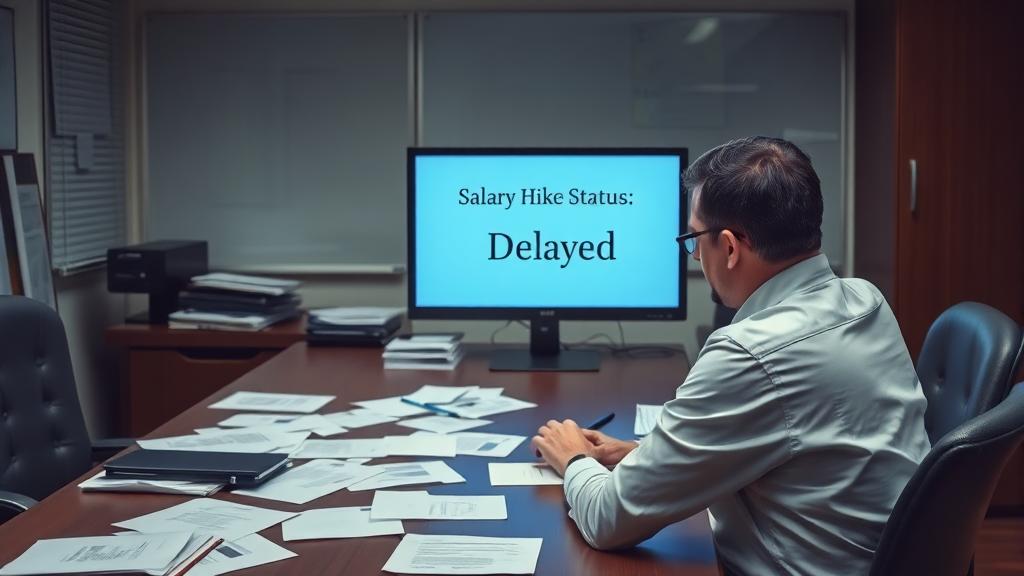
    Corporate employee staring at delayed salary hike message on office computer with frustration
    “When the screen says it all — hike delayed, mood deflated.”

    “We’re Hiring, But We’re Not Giving Hikes” – Make It Make Sense?

    What’s also weird is that hiring’s still on. Freshers are getting onboarded, some experienced roles are being filled too. So clearly, money is there.

    It’s not like TCS is broke. Far from it. Projects are running. Offices are open. There’s chai in the pantry.

    But when it comes to appraisals? Suddenly it’s all about “efficiency” and “cost optimization”.

    Honestly, sounds like corporate jugglery. Cut costs without calling it layoffs. Look “stable” to investors. Keep people in the loop, but not too happy. That’s what it feels like.

    What Employees Are Saying (Quietly)

    No one’s shouting, but the mood is low. On Slack, WhatsApp, Teams people are venting in DMs. Some were counting on the raise to plan EMIs, others were just hoping to catch up with inflation.

    Now it’s more like, “Let’s wait and see.”

    But the truth? This could easily become a trend. Delay this year, maybe trim it next year, and who knows what happens after that.

    But Is It Really Just About the US?

    Okay, sure, the global economy is shaky. Tariffs, elections, wars, AI killing budgets there’s a lot going on.

    But there’s also the inside story no one talks about openly. Companies want to show better profits. Margins were low last year. Cutting hikes makes the books look good. That’s not a conspiracy. That’s just how business works.

    You stop one hike, you save crores. Simple math.

    And if Infosys and Wipro are doing the same, well… there’s safety in numbers, right?

    What Can You Even Do?

    Honestly? Not much.

    But maybe don’t wait around hoping. Learn something new. Cloud, AI, DevOps whatever keeps you in demand.

    Start saving smart. Like seriously, don’t depend on appraisals to balance your budget. They’re not guaranteed anymore.

    And yeah, don’t blindly jump jobs either. Other companies might not be much better right now.

    Final Thought – Not The End, But Definitely a Signal

    This isn’t some tragic collapse. It’s not TCS shutting shop. But it is a warning.

    The market’s changed. The way companies work has changed. And hikes? They might not come as easily or as regularly as they used to.

    So yeah, hang in there. Upskill. Stay sharp. Keep your eyes open.

    Because if the world’s gonna throw curveballs, we better learn how to hit sixes too.

    This blog is just the start. Explore more with: TCS to delay salary hikes: We will decide within the …, says HR head